Q&A

What is the source of the water?
The water comes from the mountains in western part of Norway high above sea level
What are the advantages taking water from Aqua Norway?
The water generates from pollution free glaciers and snow reservoirs and is available in large quantities
What are the existing resources and what can Aqua Norway supply?
Every year 350 – 450 km3 renewable freshwater will run off the mainland of Norway, but only a small fraction of this large quantity can be utilized. Aqua Norway has made arrangements with source owners that have several million m3 at their disposal
Are the sources permanent and reliable?
The sources are mainly dams and reservoirs constructed in the mountains by large hydro electric power companies, everlasting and reliable. And Norway is not in an exposed position for earthquakes. Deliveries can be guaranteed on long term contracts – 10 – 20 years with option for renewal, if necessary
Are the sources placed easily accessible for export?
Aqua Norway has carefully studied the possibilities for the export of freshwater using ships of different sizes and chosen the optimal spots accordingly. Large quantities can be shipped from the outlets of the power stations. The quality of the water will not decline by the turbines.
What about the quality of the water?
The water has been analysed over years showing the same high quality from these sources.
The mineral content is very low and the same apply to the content of dissolved solids. The temperature at loading is 4 – 6 degrees C
Are there any restrictions that will apply to this trade?
From the power stations the water runs freely into the sea after passing the turbines (this does not affect the quality) and is of no more use. The companies have met the demand in their concession, i.e. producing electric power, and will be free to utilise the outlet water
Sustainability and Water
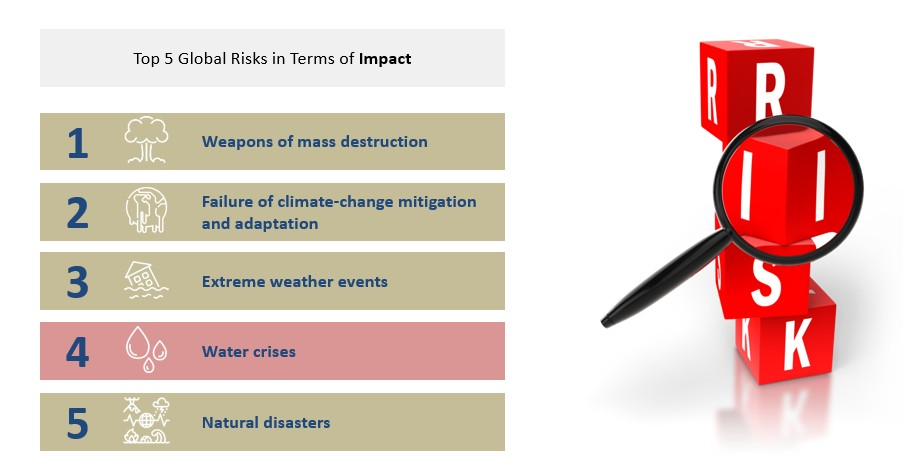
World Economic Forum
According to the WEF Global Risk Report 2019 on the global risk outlook for 2019
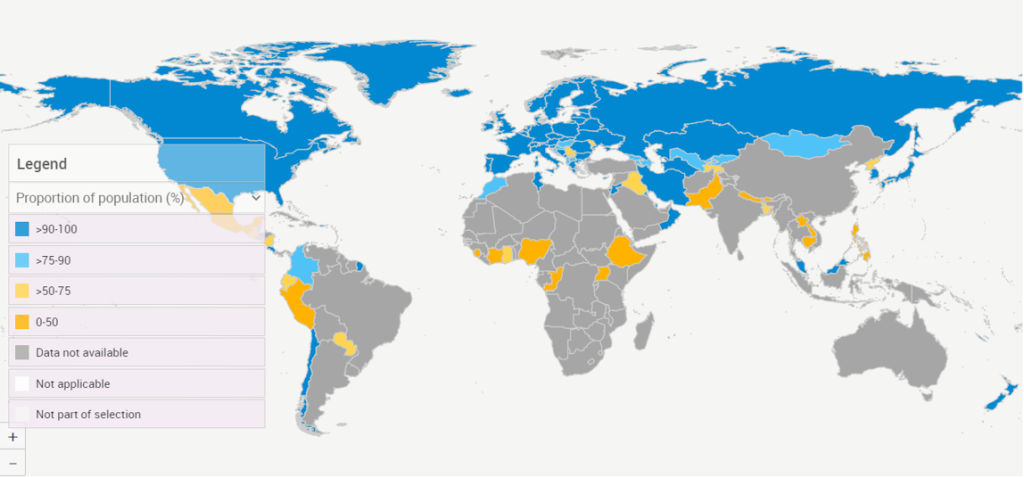
Water Contamination
Proportion of population using safely managed drinking water services with water free of contamination (sdg6data.org)
Water Scarsity
•Over 2 billion people live in countries experiencing high water stress. (UN, 2018)
•1.8 billion people use a source of drinking water contaminated with faeces, putting them at risk of contracting cholera, dysentery, typhoid and polio. (WHO/UNICEF 2015)
•700 million people worldwide could be displaced by intense water scarcity by 2030. (Global Water Institute, 2013)
•About 4 billion people, representing nearly two-thirds of the world population,
experience severe water scarcity during at least one month of the year (Mekonnen and Hoekstra, 2016)
•With the existing climate change scenario, by 2030, water scarcity in some arid and semi-arid places will displace between 24 million and 700 million people. (UN, 2009).
•A third of the world’s biggest groundwater systems are already in distress (Richey et al., 2015).
•Nearly half the global population are already living in potential waterscarce areas at least one month per year and this could increase to some 4.8–5.7 billion in 2050. About 73% of the affected people live in Asia (69% by 2050) (Burek et al., 2016).
Water and Disasters
•An average of 25.3 million people are displaced each year by sudden-onset disasters. (IDMC, 2018).
•Around 74% of all natural disasters between 2001 and 2018 were water-related and during the past 20 years, the total number of deaths caused only by floods and droughts exceeded 166,000, while floods and droughts affected over three billion people, and caused total economic damage of almost US$700 billion. (UN WWDR, 2020).
•Droughts accounted for 5% of natural disasters, affecting 1.1 billion people, killing 22,000, and causing US$100 billion in damage between 1995 and 2015. (UNISDR, 2015)
•For the 68.5 million people who have been forced to flee their homes, accessing safe water services is highly problematic. (UNHCR, 2017)
•Since 1900, more than 11 million people have died as a consequence of drought and more than 2 billion have been affected by drought, more than any other physical hazard. (FAO)
•Overall, annual economic losses from weather-related disasters are estimated at between US$ 250 billion and US$ 300 billion. (UNISDR, 2015)
•Asia is the region most vulnerable to water-related disasters, accounting for more than 45% of fatalities and more than 90% of the people affected by disasters between 1980 and 2006. (UNESCO, 2009)